


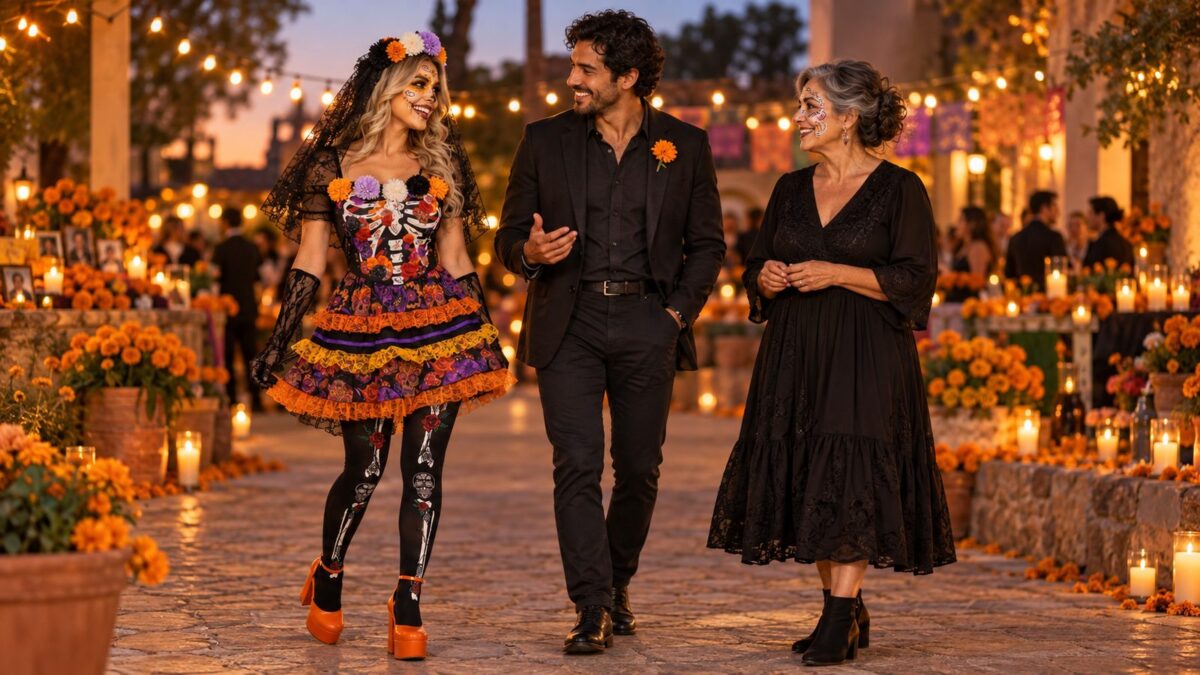
Dia de los Muertos outfits run from formal clothing styled after La Catrina to skeleton costumes and painted faces at parades, and the holiday itself, on November 1 and 2, remembers loved ones who have died. We found no source that sets a dress code. What the sources describe is dressing up as part of the festivities, so the setting, whether a parade or a family altar, shapes the outfit.
This guide covers clothing for the day, including what to wear if you skip a costume. Our Day of the Dead costume guide covers complete costumes, our men's outfits guide goes deeper on the men's cut, and our headband guide covers the headpiece.
What do people wear for Dia de los Muertos?
Dressing up is part of the festivities, and the looks vary. National Geographic describes dressing up as skeletons and painting faces to look like skulls as part of the festivities in Mexico, and it notes that people don fancy suits and gowns to mimic La Catrina. A Library of Congress folklife specialist adds that, in the modern context, the holiday is also an occasion for social gatherings, music and culture festivals, parades, and costume contests.
- At parades and festivals: skeleton costumes, painted faces, and formal Catrina-style clothing all appear. A scholar writing for The Conversation, republished by PBS NewsHour, says participants in Mexico's largest Day of the Dead celebration, the Mexico City parade, also wear Hollywood horror costumes usually reserved for Halloween.
- At a family altar or cemetery visit: a Library of Congress folklife specialist calls the holiday generally more solemn and reflective than Halloween, and none of the sources we read set a dress code for an altar or a cemetery visit. Our suggestion: dress as you would for any family remembrance.
Some of what looks traditional is newer than it appears. The Mexico City parade was first held on October 29, 2016, and the Boston Globe reported that it was inspired by a parade in a 2015 spy film and had never been part of traditional Day of the Dead celebrations. PBS NewsHour also reports that Catrina costume parades and contests are a relatively new tradition in Mexico and the U.S.
Who is La Catrina, and why does her look show up everywhere?
La Catrina is a skeleton figure in fashionable European-style clothing and an oversized feathered hat, and she is the figure the fancy suits and gowns at festivals mimic. A Mexican engraver first engraved her in 1912 as "Calavera Garbancera" (PBS NewsHour).
She got her name, Calavera Catrina, in a 1930 book of the engraver's prints, and a muralist made her the focal point of a 1947 mural that PBS NewsHour says further immortalized her.
Do you need a costume to take part?
No. Dressing up is one way to take part, and none of the sources we read make it a requirement. Our suggestion: an outfit you would wear to a family gathering, plus one clear marker from the list below.
- Flowers: the marigold, called cempasúchil, is a centerpiece of the altars families build for departed loved ones (NPR), and many families decorate graves with marigolds too (National Geographic), so orange flowers are a simple way to nod to the tradition.
- Lace: a black lace veil or a pair of lace gloves echoes La Catrina's formal look.
- Face paint: a Mexico News Daily writer argues that anyone, Mexican or foreign, can paint their face as a skull as long as it is done with respect.
If you use face paint, the FDA suggests checking that its color additives are approved for cosmetic use, and trying a dab on the arm of the person who will wear it, then waiting a couple of days to see whether a reaction shows up, before it goes on the face.
What does a ready-made women's look include?
For a parade, a festival, or a costume contest like the ones described above, a ready-made look is one option, not a requirement. Our Women's Day of the Dead Mini Dress Costume covers the dress, the headpiece, and the gloves, and it is a festival look rather than something for a cemetery visit.
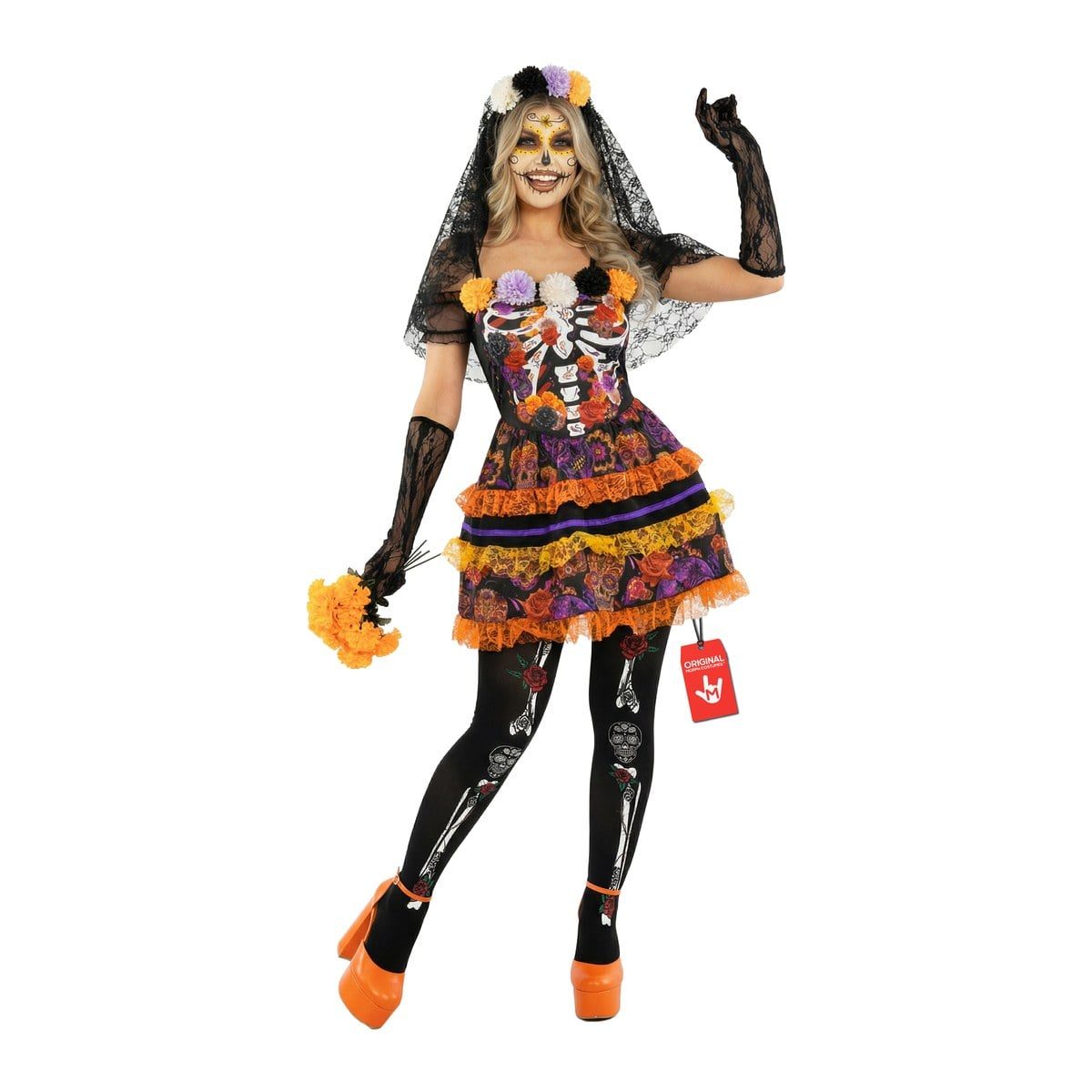
The Women's Day of the Dead Mini Dress Costume comes with a mini dress in a digital print with decorative lace, a headband with floral accents and a flowing black veil, and black gloves. The dress has a built-in elastic waist and is made from 100% polyester.
The photo also shows tights, a bouquet of marigolds, and platform shoes. Those are styling, not part of the pack.
Every costume goes through over 30 measurement checks, and separately, the size guide on the product page is the tool for choosing your size. For care, hand wash in cool water, air dry flat away from direct heat and sunlight, and never machine wash; the garment label has the final word. The rest of our range for the day sits in skeleton and Day of the Dead costumes.
What about men and kids?
For men, the same formula carries over: a dark suit, plus one marker such as a flower on the lapel or skull face paint. If you want a full costume instead, our men's Day of the Dead outfits guide lists what comes in each pack.
For kids, we did not find a source that sets what children wear, so this is our suggestion rather than a rule: clothes they can move in for a long day, plus one marker such as a headband or simple face paint. All of our kids' products are safety tested by accredited labs, and our kids' skeleton costumes and the Day of the Dead costume guide list the current options.
How do you dress with care if you are not Mexican or Latino?
Join in, and dress for remembrance rather than for Halloween. A University of Northern Colorado bilingual communication strategist, asked about non-Mexicans celebrating, answered yes for anyone who wants to honor family members who have passed away respectfully, and added that culture is always a mix. In an October 2021 Ipsos poll, 7% of Americans said they celebrate the Day of the Dead (Ipsos's headline says about one in ten plan to celebrate it), and one in four Hispanic-identifying Americans said they celebrate Dia de los Muertos.
The Library of Congress says Halloween and Dia de los Muertos have distinct beliefs and practices that should not be confused, and a scholar writing for The Conversation notes that many Latinos stress Dia de los Muertos is not a Mexican Halloween. A few things we would skip:
- Treating it as just another Halloween costume. The Mexico News Daily writer advises against wearing the skull face as part of a Halloween costume.
- Stereotype costumes. A Cal State San Marcos student research project on sugar skull imagery and cultural appropriation found that stereotypes form through misinterpretation of information, which is a good reason to learn what the symbols mean first.
- Gore. We would save blood and horror makeup for Halloween night and keep a Dia de los Muertos look about remembering someone.
- Face paint in a church or cemetery. The same writer advises visitors not to enter either with a painted face.
Frequently asked questions
What do people wear for Dia de los Muertos?
It varies by setting. At parades and festivals, sources describe skeleton costumes, painted faces, and formal clothing styled after La Catrina, while a Library of Congress folklife specialist calls the holiday itself generally more solemn and reflective than Halloween. We did not find a single required outfit in the sources we read.
Do you have to dress up for Dia de los Muertos?
No. Dressing up is part of the parades, costume contests, and festivals that sources describe, and clothes you already own plus one marker, such as flowers, a lace veil, or face paint, are a simple way to join in. If you paint your face, do it with respect and not as part of a Halloween costume.
What should you wear to a Dia de los Muertos party or festival?
Choose an outfit you can move in for a few hours, then add one clear marker such as a flower headband, a lace veil, or skull face paint. Our Women's Day of the Dead Mini Dress Costume packs the dress, a headband with a veil, and gloves together if you want the whole look in one go.
Can you wear Day of the Dead face paint if you are not Mexican?
A Mexico News Daily writer argues that anyone, Mexican or foreign, can paint their face as a skull, as long as it is done with respect. The same writer advises against treating it as part of a Halloween costume and against entering a church or cemetery with the face painted.
When is Dia de los Muertos in 2026?
The holiday is observed on November 1 and 2, which in 2026 fall on a Sunday and a Monday. National Geographic says November 1 is Dia de los Angelitos, when young children and babies who have died are remembered, and History.com says the spirits of adults return on November 2.
